H-ACD Toolkit — Human-Agent Centered Design workflow
Turned Human-Agent Centered Design into a reusable prompt workflow for discovery, delegation, trust contracts, critique, research, and iteration across AI-assisted product work.
Problem
AI product design can collapse into feature talk too quickly: add a chatbot, generate the text, summarize the table, automate the next step. That misses the harder question. When a product introduces an agent, the designer has to define the relationship between the human, the agent, and the system: who owns intent, what can be delegated, what needs preview, what gets logged, and how recovery works when the agent is wrong.
I wanted a portable way to make that discussion concrete inside product work rather than leaving Human-Agent Centered Design as an interview term or a whiteboard phrase.
Why this maps to AI Designer IC3
- Translates an emerging AI-design framework into repeatable product-design practice.
- Defines boundaries between human judgment, agent assistance, and system execution.
- Supports ambiguous AI feature discovery before committing to screens or implementation.
- Produces research questions that test trust calibration, delegation comfort, and recovery.
- Creates a shared vocabulary for product, design, and engineering conversations.
The H-ACD lens
The toolkit frames AI experiences as a triadic relationship:
Human -> Agent -> System
intent   interpretation and bounded action   reliability, traceability, scale
For each AI-assisted workflow, the design questions become:
- What is the user’s intent, separate from the steps they currently take?
- What is the agent allowed to draft, recommend, summarize, or execute?
- What needs an intent preview before the system acts?
- What actions require explicit authorization?
- What gets logged, reversed, or escalated when the agent fails?
The goal is not maximum autonomy. The goal is calibrated autonomy: enough help to reduce effort, enough legibility to preserve trust.
What’s actually built
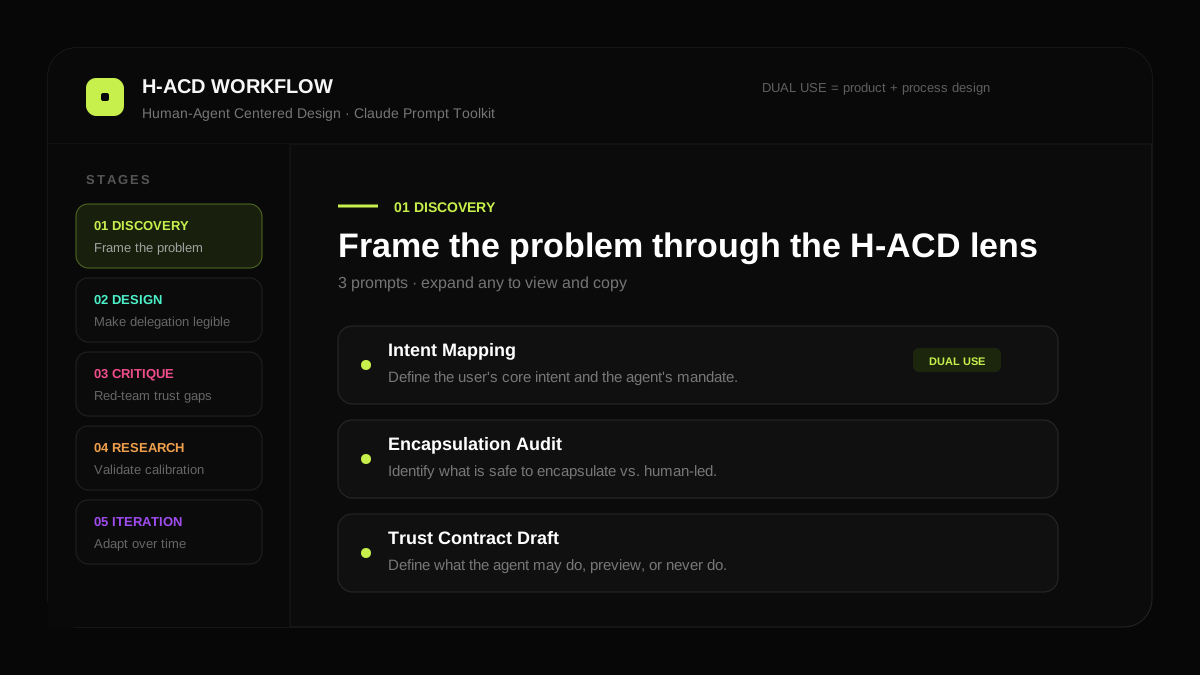
The artifact is a reusable prompt workflow with five stages:
- Discovery — intent mapping, encapsulation audit, trust contract draft.
- Design — autonomy dial, intent preview, action audit log.
- Critique — heuristic review, trust failure scenarios, power-vs-casual user audit.
- Research & Testing — research plan, trust calibration test, delegation comfort probe, failure recovery testing, synthesis.
- Iteration — feedback loop design and autonomy expansion plan.
How I’d use it at ClassLink
For an AI-assisted app description workflow, H-ACD keeps the interaction honest:
- Human intent: “Help me create a clear app description for district users.”
- Agent role: draft language, suggest improvements, identify missing clarity.
- System boundary: editable output, loading/error states, no publish until explicit save.
- Trust contract: draft and regenerate are safe; save/publish always requires confirmation.
- Recovery path: reject output, edit manually, regenerate, or return to previous saved copy.
For higher-stakes admin workflows, like rostering, identity management, audit summaries, or policy-risk surfacing, the same lens would tighten autonomy. The agent can summarize, recommend, or preview actions, but final execution needs traceable confirmation.
What I’d discuss in an interview
I would not lead with the acronym. I would use it to explain my operating model:
I use a Human-Agent Centered Design lens for AI features. The human owns intent and judgment. The agent can draft, recommend, summarize, or orchestrate bounded work. The system has to expose state, constraints, provenance, and recovery paths so users stay oriented and in control.
That framing turns AI design from “what can the model do?” into “what relationship should the product create between the person, the agent, and the system?”
What I’d do differently
- Turn the prompts into product-specific presets. CMC Modules, LaunchPad, and My Files each need different autonomy defaults and risk thresholds.
- Add scoring. The critique stage should produce a small H-ACD scorecard: intent legibility, delegation safety, trust calibration, accountability, and recovery.
- Link to real research sessions. The research prompts should generate a study plan that can be saved next to usability findings and synthetic persona reports.
- Move from prompt toolkit to product pattern library. Autonomy Dial, Intent Preview, and Action Audit Log should eventually become documented design-system patterns.
Attribution: H-ACD framework language adapted from Itamar Medeiros / designative.info, 2025.