/design-flow — the meta-artifact
AI-assisted design workflow that structures discovery, research, prototyping, review, and iteration into a repeatable product-design loop.
Problem
Asking an agent to “design and build a launchpad” produces something. Asking an agent to “design and build your launchpad” produces nothing useful — the model has no opinion about your taste, your users, your constraints, and the resulting work feels generic because it is.
I kept rebuilding the same structure by hand: a discovery interview, a taste calibration, three visual directions, a chosen blend, the build, a UX review, fixes, a retrospective. After the fourth time it became obvious this was the artifact.
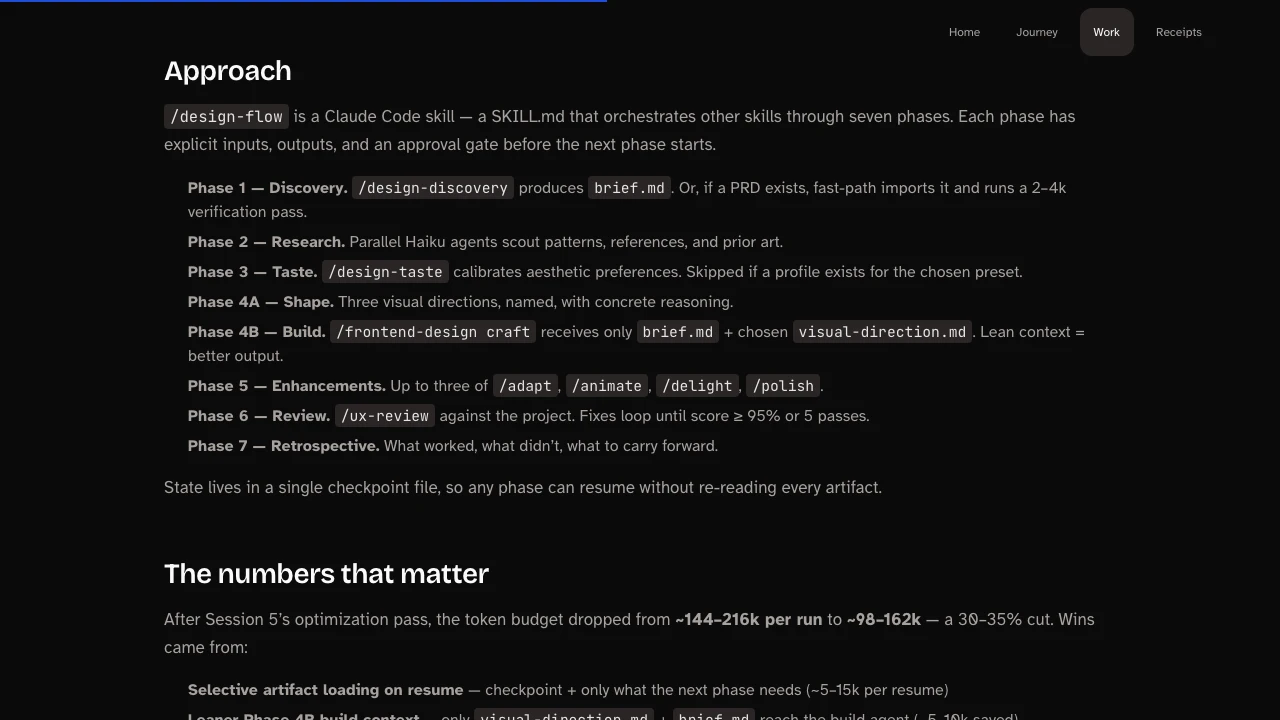
Approach
/design-flow is a Claude Code skill — a SKILL.md that orchestrates other skills through seven
phases. Each phase has explicit inputs, outputs, and an approval gate before the next phase
starts.
- Phase 1 — Discovery.
/design-discoveryproducesbrief.md. Or, if a PRD exists, fast-path imports it and runs a 2–4k verification pass. - Phase 2 — Research. Parallel Haiku agents scout patterns, references, and prior art.
- Phase 3 — Taste.
/design-tastecalibrates aesthetic preferences. Skipped if a profile exists for the chosen preset. - Phase 4A — Shape. Three visual directions, named, with concrete reasoning.
- Phase 4B — Build.
/frontend-design craftreceives onlybrief.md+ chosenvisual-direction.md. Lean context = better output. - Phase 5 — Enhancements. Up to three of
/adapt,/animate,/delight,/polish. - Phase 6 — Review.
/ux-reviewagainst the project. Fixes loop until score ≥ 95% or 5 passes. - Phase 7 — Retrospective. What worked, what didn’t, what to carry forward.
State lives in a single checkpoint file, so any phase can resume without re-reading every artifact.
The numbers that matter
After Session 5’s optimization pass, the token budget dropped from ~144–216k per run to ~98–162k — a 30–35% cut. Wins came from:
- Selective artifact loading on resume — checkpoint + only what the next phase needs (~5–15k per resume)
- Leaner Phase 4B build context — only
visual-direction.md+brief.mdreach the build agent (~5–10k saved) - Capped enhancement passes — three max per run; dropped
/refineas redundant with/polish - Sonnet routing — Phases 3 (taste) and 7 (retrospective) run on Sonnet since neither needs code generation
Why this is the most-reused thing I’ve built
Because every prototype since the parent-portal proving ground has run through it, including the launchpad
case study. Skills compose: /design-flow calls /ux-review which calls /critique which
references /design-memory. Each one is small and replaceable; the orchestration is what
makes the whole thing feel like a process instead of a series of prompts.
The first time you build the orchestrator, it feels like overhead. The fourth time, it feels like the only sane way to design.
What I’d do differently
- Stack mismatch detection at startup. Right now you can ask
/design-flowto build an Angular app inside a React project and it’ll cheerfully comply for a while before things break. - Preset-scoped taste profiles.
taste-profile-launchpad.md,taste-profile-insights.md— one file per product surface so the calibration phase has somewhere to land. /design-flow estimate— a dry-run that reports the projected token spend before committing to a full run.- Post-completion
/linear-prdhandoff — automatically file the produced artifacts as Linear issues for follow-up.